
Technology Labs
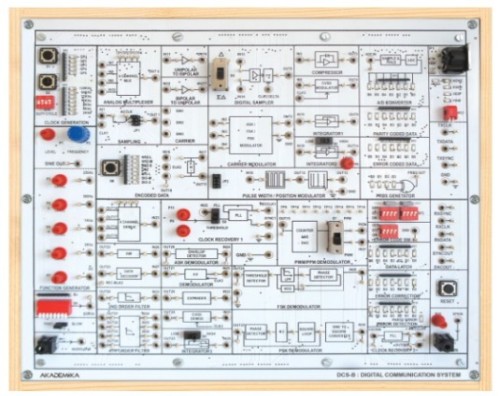
DCS-B: Basic Digital Communication Training System
About Product
The DCS-B Training System provides a comprehensive platform to learn core digital communication techniques, including sampling, PCM, TDM, digital line coding, and ASK/FSK/PSK modulation schemes. With onboard generators, voice communication support, and built-in error detection/correction modules, it enables complete transmitter-to-receiver experimentation for foundational learning.
Single Board System Design using VLSI Technology.
Covers all Basic Digital Modulation Techniques.
All Generator resources provided on board.
Voice Communication.
Exhaustive Manual.
Sampling clock
Frequency : 2KHz, 4KHz, 8KHz, 16KHz,32KHz, 64KHz, 128KHz
Dutycycle : 10 ~ 90%Selectable in steps of 10%
DCsignal : 0 ~ 5V
Transmitterclock frequency : 240KHz fast modes
Transmitterframe frequency : 8KHz
Carriersine waves : 500KHz (00 ), 1MHz(00), 1MHz (1800)
Datapattern : 8-bit variableNRZ-L pattern
PRBS generator : 14-BiTransmitter section
Analog signal sampling
Sample and Hold
Natural sampling
Flat-top sampling
4channel analog time division multiplexing
Odd,Even parity and Hamming code generator
Pulsecode modulation
Dataencoding NRZ (L), NRZ (M), NRZ(S), Bi-phase (Manchester), Bi-phase (Mark),Bi-phase (Space),
URZ,Alternate Mark Inversion (AMI), Uni-polar to Bipolar and Bipolar to Uni-polaro ASK,FSK, PSK modulation.
Delta/ Adaptive delta / Sigma delta / CVSD modulation.
Signalcompression.
PAM/ PPM / PWM modulation
Audio preamplifier with microphone interfaceReceiver section
2nd order and 4th order low pass Butterworth filters.
4channel time division de-multiplexing.
PLLclock recovery.
Odd,even parity and hamming code recovery
Single-bit error detection and correction.
Pulsecode demodulation
Datadecoding NRZ(L), NRZ(M), NRZ(S), Bi-phase (Manchester), Bi-phase (Mark),Bi-phase (Space),
URZ,alternate mark inversion (AMI)
ASK,FSK, PSK demodulation.
Delta/ adaptive delta / sigma delta / CVSD demodulation.
Signalexpander.
PAM/ PPM / PWM demodulation.
Audio amplifier with headphone / speaker interface.
Study of sampling techniques
Natural sampling
Sample and hold
Flat top samplingEffect of various sampling frequencies and duty cycles
Effectof sampling frequency
Effectof duty cycleEffect of order of the low pass filter
Study of TDM with different receiver synchronization techniques
Usingthe direct synchronization technique
Clockrecovery through PLI
Clockrecovery through threshold detectorStudy of pulse code modulation and demodulation
Direct synchronization technique
Bit synchronization technique
Framesynchronization techniqueEffects of parities and hamming code on PCM data
None parity
Even parity
Odd parity
HammingcodeStudy of PRBS
Study of various data encoding and decoding techniques
NRZ-L, NRZ- M, NRZ- S. BIO- L. BlO- M, BIO- S. URZ
AMIencoding and decoding
Unipolar to Bipolar
Bipolarto unipolarStudy of various carrier modulation and demodulation techniques
ASK modulation and demodulation
FSK modulation and demodulation.
PSK modulation and demodulation.
Study of delta modulation and demodulation.
Study of slope overload and increased integrator gain.
Study of adaptive delta modulation and demodulation.
Study of sigma delta modulation and demodulation.
Study of continuously variable slope detector modulation and demodulation.
Study of companding system.
Study of pulse width modulation and demodulation.
Study of pulse position modulation and demodulation.
Voice communication.
Switch faults.
With 35 years of legacy in Technical Education, Akademika extends its expertise to Defence and Skill development, building Innovative, Reliable Training Systems for the next generation of Learners.
Partner with Akademika
Join leading institutions that trust our engineering to Advance Learning and Research.