
Technology Labs
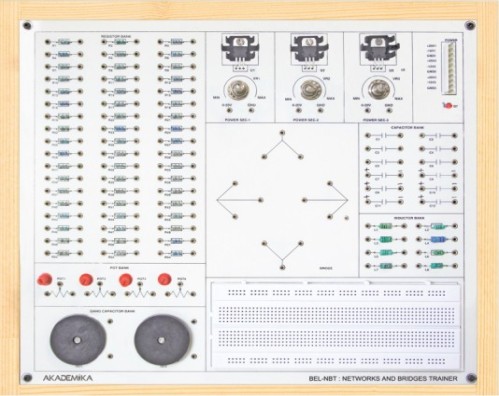
BEL-NBT: Network And Bridges Trainer
About Product
A complete trainer that enables students to verify core electrical theorems and characterize AC bridges with built-in R, L, C banks and a solder-less proto area. Covers Superposition, Thevenin, Norton, Maximum Power Transfer, Reciprocity, KCL/KVL, and advanced bridges including Hay’s, Schering, Anderson, Owen’s and LC resonance.
Single board system, capable of covering minimum 10 Experiments.
IEEE Symbol of all components provided on the PCB On-board components.
Demonstrates the basic theorems, the two port network parameters, different AC bridges andperform analysis of network.
Power Supply:
Fixed Power Supply +25V1, -12V1, GND1, +25V2, -12V2, GND2, +25V3, -12V3, GND3Variable current source should be provided
On-board components:
On-board power supply, Resistor, Capacitor, Inductor bank
Breadboard (175mmX63mm) area to allow construction of circuits using external components along with on board resources.
Resistor Bank: 54 nos.
Range from 4.7ῼ to 150K.Capacitor Bank: 12 nos.
Range from 33µF to 47PF
Gang capacitors: pF and µFInductor Bank: 8 nos.
Range from 1mH to 10µHPotentiometer Bank: 4 nos.
Range from 1K to 100K.Interconnection points & test points
Superposition theorem
Thevenin's theorem
Norton's theorem
Maximum power transfer theorem
Reciprocity theorem
Two port network parameter ( Z and Y parameter )
To find unknown resistance using Wheatstone bridge
To find unknown capacitance using De'saunty's bridge
To find unknown low resistance using Kelvin's bridge
Maxvell’s theorem
Verification of Ohm's law
Verification of Kirchoff's law (KCL and KVL)
Verification of Mesh current analysis
Verification of Nodal voltage analysis
Verification of source transformation
To verify compensation theorem
Study of resistor ladder network
To verify Millman's theorem
Assignments
Hay’s bridge
Schering bridge
Andersen bridge
Owne’s bridge
LC resonance
With 35 years of legacy in Technical Education, Akademika extends its expertise to Defence and Skill development, building Innovative, Reliable Training Systems for the next generation of Learners.
Partner with Akademika
Join leading institutions that trust our engineering to Advance Learning and Research.